
The D-CONNECT Multi Loose Tube Fiber Optic Cable is a high-capacity unarmoured backbone solution supporting 24 to 288 fiber cores. Designed for indoor and protected outdoor installations, it offers gel-filled moisture protection, water-blocking yarns, and flexible customization for telecom and data networks.
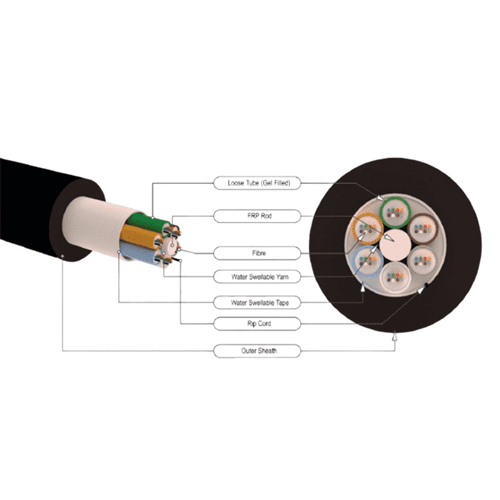
The D-CONNECT Multi Loose Tube Fiber Optic Cable is a high-performance unarmoured backbone fiber optic cable developed for telecommunication, enterprise, and data center network infrastructure. Supporting 24 to 288 fiber cores, this cable is ideal for medium to large-scale fiber backbone and distribution networks requiring stable transmission, long service life, and cost-effective deployment.
Available with OS2 single-mode and OM1, OM2, OM3, OM4, and OM5 multimode fibers, it ensures compatibility with modern high-speed network architectures. The gel-filled loose tube construction provides excellent moisture resistance, protecting optical fibers from environmental stress and ensuring long-term reliability.
To further enhance durability, water-blocking glass yarns protect against water ingress, making the cable suitable for duct, conduit, and protected outdoor installations. Its lightweight and compact design allows easy handling, transport, and fast installation, reducing overall deployment time and cost.
Engineered to perform across a wide temperature range, and available with multiple outer jacket materials and color options, the D-CONNECT Multi Loose Tube Unarmoured Fiber Optic Cable delivers the flexibility and performance required for modern broadband networks, telecom backbones, campus networks, and data center interconnections.
The Dconnect Multi Tube Unarmoured Fiber Optic Cable is manufactured in accordance with the highest international quality and performance standards to ensure reliability, safety, and interoperability across a wide range of applications.
ITU-T Standards:
G.652D, G.657A1/A2 (Single-mode)
G.651.1 (Multimode: OM1, OM2, OM3, OM4, OM5)
IEC Standards:
IEC 60794-1: Optical Fiber Cable General Specifications
IEC 60794-2: Indoor Cable Specifications
IEC 60794-3: Outdoor Cable Specifications
IEC 60794-5: Microduct and Outdoor Drop Cables
IEC 60332-1 & IEC 60332-3: Flame Retardancy (if LSZH jacket is selected)
ISO/IEC Compliance:
ISO/IEC 11801: Structured Cabling for Generic Networks
ISO 9001: Quality Management System
Environmental and Safety Compliance:
RoHS (Restriction of Hazardous Substances) Compliant
REACH Compliant
UV Resistant (for outdoor-rated jacket)
Halogen-Free (if LSZH jacket is used)
Fiber Counts: 24F, 48F, 96F, 144F, 288F
Moisture Barrier: Water-swellable yarn & tape
Loose Tube (PBT): Sizes vary by fiber count (1.2–2.2 mm OD)
Central Strength Member: FRP rod (2.0–3.5 mm)
Outer Sheath: LSOH, Black, 1.5 mm nominal
Overall Diameter: 9.0–16.5 mm
Weight: 85–240 kg/km
Tensile Strength: Up to 4000 N
Crush Resistance: 2000 N
Impact Strength: Up to 25 N·m
Torsion Resistance: ±180°
Min. Bend Radius: 20 × cable diameter
| Type | Attenuation | Bend Resistance |
| G.652D | ≤ 0.35 dB/km @ 1310 nm | Moderate |
| ≤ 0.22 dB/km @ 1550 nm | ||
| G.657A1 | Similar to G.652D | Low bend loss @ 10 mm radius |
| G.657A2 | Similar to G.652D | Ultra-low bend loss @ 7.5 mm radius |
| OS1 | ≤ 1.0 dB/km @ 1310 nm | Moderate |
| ≤ 0.7 dB/km @ 1550 nm | ||
| OS2 | ≤ 0.4 dB/km @ 1310 nm | Low |
| ≤ 0.3 dB/km @ 1550 nm | ||
| OM3 | ≤ 2.3 dB/km @ 850 nm | Standard |
| ≤ 0.6 dB/km @ 1300 nm | ||
| OM4 | ≤ 2.3 dB/km @ 850 nm | Standard |
| ≤ 0.6 dB/km @ 1300 nm | ||
| OM5 | ≤ 2.3 dB/km @ 850/953/1300 nm | Standard |
Telecommunications: High-speed internet, voice, and video over long distances.
Data Centers: High-bandwidth links between servers, switches, and storage.
FTTH (Fiber to the Home): Direct internet and TV delivery to residential users.
Enterprise Networks: Building backbones and campus interconnections.
Industrial & Outdoor Use: Harsh environments like smart grids, oil & gas, and surveillance.
Metro & Backbone Networks: Long-haul and metro fiber connecting cities and providers.
Backbone Cabling: In commercial buildings, data centers, and enterprises.
Distribution Networks: From MDF to intermediate/zone frames.
Indoor & Protected Outdoor Routing: Riser shafts, trays, ducts, and conduits.
Campus Area Networks (CAN): Multi-building connectivity.
FTTx Deployments: Secure, high-density fiber infrastructures.
LAN & WAN Links: High-bandwidth, low-latency network connections. Metro & Backbone Networks: Connect cities and service providers via long-haul and metro fiber.