
The DCONNECT Indoor Distribution Tight Buffer Fiber Optic Cable is a high-performance solution for commercial indoor fiber distribution networks. Designed for office buildings, data centers, and enterprise structured cabling projects, this tight buffer OS2 fiber optic cable features bend-insensitive G.657A2 fibers, aramid yarn strength members, and a yellow LSZH jacket to deliver reliable connectivity and fire-safe indoor installation.
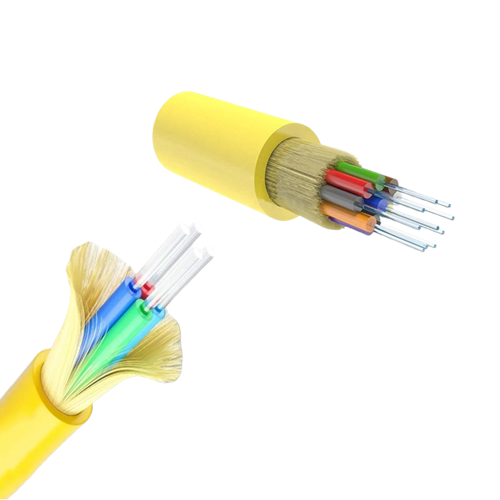
The DCONNECT Indoor Distribution Tight Buffer Fiber Optic Cable is designed for high-performance indoor fiber distribution in commercial and enterprise networks. It features bend-insensitive G.657A2 single-mode OS2 fibers for stable signal transmission in tight routing spaces, along with tight buffer construction for easy termination and splicing.
Reinforced with a high-strength aramid yarn strength member, the cable provides reliable mechanical protection during installation. Its yellow LSZH outer jacket enhances fire safety and visibility, making it ideal for indoor backbone cabling, structured networks, and fiber-to-the-desk applications.
This cable is well-suited for deployment in conduits, cable trays, and riser pathways, where organized routing and compliance with indoor installation standards are required. The tight buffer design supports clean cable management and simplifies maintenance in dense networking environments.
With a focus on optical stability, mechanical durability, and fire-safe construction, the DCONNECT Indoor Distribution Tight Buffer Fiber Optic Cable provides a dependable solution for modern commercial fiber infrastructure and structured cabling projects.
The DCONNECT Indoor Distribution Tight Buffer Fiber Optic Cables are designed, manufactured, and rigorously tested to meet the following international standards and compliance requirements:
ITU-T G.657A2 – Bend-insensitive single-mode optical fiber specification
ITU-T G.652D – Standard single-mode optical fiber characteristics (optional variant, if applicable)
IEC 60793-1 & 60793-2 – Optical fiber generic and product specifications
IEC 60794-2 – Indoor optical fiber cable construction and performance standards
IEC 60332-1 – Flame retardant performance for single insulated cable
IEC 60754-1/2 – Halogen-free and low corrosivity of combustion gases
IEC 61034 – Measurement of smoke density of burning cables
TIA/EIA-568-C – Color coding for optical fibers
Telcordia GR-409 – Generic requirements for indoor fiber optic cables
RoHS & REACH Compliant – Ensures environmentally safe and non-hazardous materials
| parameter | Specification |
| Fiber Type | Single-mode OS2 (ITU-T G.657A2) |
| Construction | Tight buffer with aramid yarn strength member |
| Jacket Material | Low Smoke Zero Halogen (LSZH) |
| Jacket Color | Yellow |
| Outer Diameter | Approx. 2.0 mm (1F), 6.0 mm (12F)* |
| Cable Weight | Approx. 20 – 50 kg/km* |
| Minimum Bend Radius | 10 × OD (installation), 5 × OD (operation) |
| Tensile Strength (Short-term) | ≥ 600 N* |
| Tensile Strength (Long-term) | ≥ 200 N* |
| Crush Resistance | ≥ 1000 N/100 mm* |
| Operating Temperature | -20°C to +70°C |
| Storage Temperature | -40°C to +70°C |
| Installation Temperature | -10°C to +50°C |
| Service Life | 30 years (typical) |
| Parameter | Value |
| Attenuation @1310 nm | ≤ 0.36 dB/km |
| Attenuation @1550 nm | ≤ 0.23 dB/km |
| Cable Cutoff Wavelength (λcc) | ≤ 1260 nm |
| Polarization Mode Dispersion (PMD) | ≤ 0.2 ps/√km |
| Mechanical & Environmental Characteristics | |
| Test Parameter | Specification |
| Temperature Range (IEC 60794-1-2-F1) | Installation: -5°C to +45°C |
| Operation: -30°C to +60°C | |
| Transport & Storage: -40°C to +70°C | |
| Cable Bending Radius (IEC 60794-1-2-E11A) | Static: 15 × D |
| Dynamic: 10 × D | |
| Tensile Strength (IEC 60794-1-2-E1) | 1 × W × 9.81 (W = weight/km) |
| Crush Resistance (IEC 60794-1-2-E3) | 100 N/10 cm |
| Impact Resistance (IEC 60794-1-2-E4) | 3 Nm |
| Torsion | ±180°, L = 40N |
| Backbone Cabling: Vertical and horizontal backbone fiber cabling within commercial and residential buildings |
| Data Centers: High-density interconnection between racks, ODFs, and network equipment |
| FTTX Deployments: Ideal for fiber-to-the-home (FTTH), fiber-to-the-building (FTTB), and multi-dwelling units (MDUs) |
| Enterprise Networks: Fiber distribution for large office campuses and high-performance enterprise networks |
| Telecommunication Rooms: Efficient connectivity between intermediate distribution frames and main distribution frames |
| Fiber-to-the-Desk (FTTD): Direct fiber drops to workstations and user terminals |
| Riser Installations: Suitable for vertical runs in building riser shafts, compliant with LSZH fire safety requirements |
| Indoor Cable Trays and Conduits: Designed for flexible routing in structured cabling systems |