Imagine your telecom network going dark in the middle of a July afternoon in Riyadh, Dubai, or Lagos, not because of a software fault, but because the equipment inside an outdoor cabinet simply overheated. It happens more often than most network operators want to admit.
Outdoor telecom cabinets house some of the most critical network infrastructure on the planet routers, switches, fiber distribution units, power modules, and more. When these cabinets are exposed to extreme ambient temperatures, intense solar radiation, dust, and high humidity, the equipment inside can fail prematurely or shut down entirely.
This guide is for network engineers, telecom contractors, procurement teams, and infrastructure buyers across the GCC, East Africa, West Africa, and beyond who need to understand how outdoor telecom cabinet cooling works, why it matters, and how to choose the right solution for your environment.
Outdoor telecom cabinet cooling refers to the integrated systems and techniques used to regulate the internal temperature of outdoor enclosures housing telecom and network equipment, preventing heat-related failure, extending hardware lifespan, and ensuring continuous network uptime.
Why Heat Is the Number One Enemy of Outdoor Telecom Equipment
Electronics and heat do not mix well. Every electronic component, from microprocessors and transceivers to power supplies and batteries, has a maximum operating temperature. Exceed that threshold, and you are looking at performance throttling, data errors, hardware alarms, or complete failure.
The thermal reality in the Gulf and Africa: Ambient temperatures in the UAE, Saudi Arabia, Kuwait, Qatar, Oman, and Bahrain regularly exceed 45°C (113°F) in summer. In countries like Nigeria, Ghana, Kenya, Tanzania, Uganda, and Ethiopia, sustained temperatures of 35–42°C are common, often combined with high humidity that further limits cooling efficiency.
The Real Cost of Thermal Mismanagement
- Network downtime that disrupts service for thousands of subscribers
- Premature failure of switches, routers, OLT/ONU equipment, and fiber modules
- Costly emergency replacement of field equipment
- Reduced battery life in integrated UPS and power cabinets
- Higher OPEX due to reactive maintenance instead of preventive management
Industry data point: According to research standards published by ASHRAE (American Society of Heating, Refrigerating and Air-Conditioning Engineers), for every 10°C rise above the recommended operating temperature, electronic component lifespan is reduced by approximately 50%. That is a statistic no telecom operator can afford to ignore.
What Is an Outdoor Telecom Cabinet? A Clear Definition
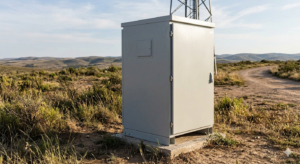
An outdoor telecom cabinet, also called an outdoor network enclosure, street cabinet, field cabinet, or outdoor equipment shelter is a weatherproof, protective housing designed to hold active and passive network equipment in environments exposed to outdoor conditions: sun, rain, dust, wind, and extreme temperatures.
Common Equipment Housed Inside Outdoor Telecom Cabinets
- Fiber optic distribution equipment (OLT, ONU, splitters, patch panels)
- Active networking gear (switches, routers, media converters)
- Power distribution units (PDUs) and rectifiers
- UPS systems and batteries
- Environmental monitoring sensors
- CCTV and surveillance controllers
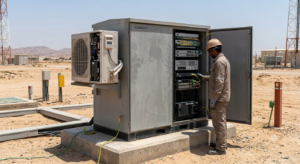
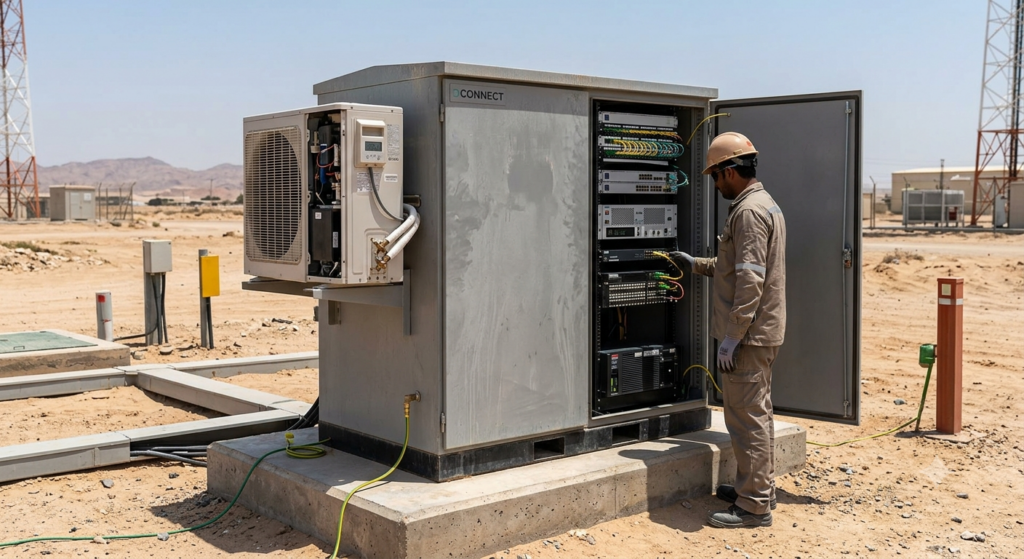
At DConnect, our Industrial Outdoor Cabinets and Intelligent Outdoor Integrated Cabinets are purpose-built for these deployments, with integrated cooling options ranging from passive ventilation to active air-conditioning units all rated for the harshest outdoor environments.
How Outdoor Telecom Cabinet Cooling Works: The Core Mechanisms
There is no single universal cooling method for outdoor telecom cabinets. The right approach depends on your local climate, the heat load generated by equipment inside, available power, cabinet size, and the specific location of deployment. Here is a breakdown of the main cooling technologies used today.
1. Passive Ventilation (Natural Airflow)
This is the simplest and most cost-effective approach. The cabinet uses filtered air vents or perforated panels to allow outside air to flow through, carrying heat away from equipment. It works well in mild climates where ambient temperatures stay below 35°C and the equipment heat load is low.
- Best for: Mild-climate locations, low-density deployments, cost-sensitive projects
- Limitation: Not suitable for Gulf states where outdoor temps routinely exceed 45°C
2. Forced Air Cooling (Active Fan Systems)
Thermostat-controlled fans inside the cabinet create positive or negative airflow, pushing hot air out and drawing cooler air in through filtered inlets. Fan systems are effective when ambient temperatures are moderate and when the equipment inside does not produce extreme heat loads.
- Best for: Mild to warm climates: parts of Africa like Rwanda, Uganda, Kenya, and Ethiopia
- Limitation: In hot climates, introducing outside air at 45°C still results in unacceptably high internal temperatures
3. Air-to-Air Heat Exchangers
A heat exchanger moves heat from inside the cabinet to outside without mixing the internal and external air streams. This keeps dust, sand, and moisture out while still dissipating heat effectively. It is a particularly popular choice in dusty environments such as desert regions in the GCC, Libya, and Egypt.
- Best for: Dusty, sandy environments, Saudi Arabia, UAE, Iraq, Libya, Egypt, Oman, Azerbaijan
- Key benefit: No direct air exchange means IP55/IP65 rating can be maintained
4. Integrated Air Conditioning Units (Cabinet AC)
For high heat loads and extreme ambient temperatures, a dedicated cabinet air conditioner is the most reliable solution. These units are mounted directly on the cabinet and provide active cooling using a refrigerant cycle, similar to a conventional AC unit, but optimized for telecom enclosures.
- Best for: Gulf states: UAE, Saudi Arabia, Kuwait, Qatar, Bahrain, Oman and hot regions of Africa
- Key specs to look for: Cooling capacity (BTU/hr or Watts), operating temperature range, IP rating, MTBF
DConnect’s Industrial Outdoor Cabinet AC units are factory-integrated with precision cooling systems designed to maintain internal temperatures between 18–25°C even when external temperatures soar past 50°C.
5. Thermoelectric Cooling (Peltier Modules)
Thermoelectric coolers use the Peltier effect to transfer heat from inside to outside the cabinet electronically, with no moving parts and no refrigerants. They are compact, silent, and highly reliable, though they are best suited for smaller cabinets and lower heat loads.
- Best for: Small outdoor enclosures, remote locations with limited maintenance access
Key Features to Look for in an Outdoor Telecom Cabinet with Cooling
Not all outdoor cabinets are created equal. When you are buying for deployments in the Gulf or Africa, here are the specifications that genuinely matter.
IP Rating (Ingress Protection)
The IP rating tells you how well the cabinet is sealed against dust and water. For outdoor deployments, you generally want IP55 as a minimum, and IP65 or higher for harsh environments. IP65 means the cabinet is completely dust-tight and protected against water jets from any direction.
IK Rating (Impact Protection)
The IK rating measures resistance to mechanical impact, important for roadside deployments, industrial zones, and any location where vandalism or accidental impact is a risk. IK08 or IK10 is recommended for public-facing installations.
Cooling Capacity and Heat Load Calculation
Before selecting a cooling method, calculate the total heat load of all equipment inside the cabinet (measured in Watts). Add a 20–30% safety margin to that number when sizing your cooling unit. Under-sizing your cooling is one of the most common and costly mistakes in the field.
Solar Radiation Protection (Anti-Sun Design)
In the Gulf and Sub-Saharan Africa, solar radiation can add 10–15°C to the surface temperature of an outdoor cabinet beyond the ambient air temperature. Look for cabinets with double-wall construction, reflective exterior coatings (RAL 7035 light grey), and integrated sun shades or canopies.
Corrosion Resistance
In coastal areas like Abu Dhabi, Dubai, Muscat, Djibouti, Mombasa, Lagos, and Dar es Salaam, salt air accelerates corrosion of metal cabinets. Choose cabinets with hot-dip galvanized or powder-coated steel, or aluminum enclosures for coastal deployments.
Intelligent Thermal Management and Remote Monitoring
Modern intelligent outdoor cabinets include embedded temperature sensors, humidity sensors, door-open alarms, and remote monitoring interfaces (SNMP, Modbus, 4G/LTE). This allows network operations centers (NOCs) to monitor cabinet conditions in real time and receive alerts before a thermal issue becomes a failure.
Installation Guide: How to Set Up Outdoor Telecom Cabinet Cooling Correctly
Getting the installation right from day one saves you thousands in reactive maintenance costs. Here is a practical installation framework.
- Site Survey and Thermal Assessment: Measure peak ambient temperature, solar radiation exposure, humidity, and dust levels at the installation site. This determines your baseline cooling requirement.
- Equipment Heat Load Calculation: Sum the thermal dissipation (in Watts) of every device that will be installed. Check vendor datasheets for TDP (Thermal Design Power) values. Add 25% headroom.
- Cooling Method Selection: Based on ambient temperature and heat load, select passive ventilation, forced air, heat exchanger, or AC cooling. In Gulf climates, active AC is almost always required.
- Cabinet Positioning: Orient the cabinet so its doors face away from direct sun (north-facing preferred). Install on a raised plinth to avoid ground-level flooding and heat absorption.
- Cable Entry Sealing: Use gland plates and cable sealing glands for all cable entries. Unsealed entry points destroy your IP rating and introduce dust, moisture, and insects.
- Internal Airflow Optimization: Install equipment following a cold-aisle/hot-aisle logic even inside the cabinet. Leave air gaps between high-heat devices. Use blanking panels to prevent hot air recirculation.
- Sensor Commissioning and NOC Integration: Configure temperature alarms at 35°C warning and 45°C critical thresholds. Connect monitoring to your network management system for real-time visibility.
Climate-Specific Cooling Recommendations by Region
Because DConnect serves a diverse range of geographies from the extreme heat of the Gulf to the tropical humidity of Central Africa here is a region-by-region breakdown of what works best.
GCC Countries (UAE, Saudi Arabia, Kuwait, Qatar, Bahrain, Oman)
Peak temperatures of 45–52°C, intense solar radiation, dust storms, and high summer humidity make this the most thermally challenging telecom environment in the world. Active AC cooling is not optional it is essential. Cabinet AC units with a cooling capacity of at least 1,000W to 2,000W+ are standard here, paired with double-wall insulation and reflective exterior finishes.
North Africa (Egypt, Libya, Morocco)
Similar heat to the GCC but with added concerns about dust and sand infiltration, particularly in Libya and Egypt. Heat exchangers or cabinet AC units with high-performance dust filtration are the preferred choice. Morocco’s coastal cities like Casablanca benefit from more moderate temperatures but still require IP65 protection against humidity.
West Africa (Nigeria, Ghana)
High heat combined with very high humidity, especially during rainy season, creates a demanding dual challenge: cooling and moisture control. Vapor barriers, dehumidifiers integrated into cooling units, and corrosion-resistant cabinet materials are important here. Active cooling is strongly recommended for equipment-dense installations.
East Africa (Kenya, Tanzania, Uganda, Ethiopia, Rwanda, Somalia & Somaliland, Djibouti)
Many parts of East Africa benefit from higher elevation and more moderate temperatures than the Gulf, making forced-air cooling viable in highland areas. However, coastal cities like Mombasa, Dar es Salaam, and Djibouti combine high temperatures with extreme humidity, requiring active cooling solutions. Djibouti, as one of the hottest countries on earth, presents conditions close to GCC levels.
Central Africa (Democratic Republic of Congo)
The DRC presents a unique tropical environment with high year-round humidity and temperatures, where corrosion and moisture ingress are as significant a threat as heat. Sealed, climate-controlled cabinets with active dehumidification are the recommended approach for mission-critical deployments.
Azerbaijan and the Caucasus Region
Azerbaijan experiences hot summers (up to 42°C) and cold winters, creating a wide temperature range. Outdoor cabinets here need both cooling for summer months and anti-condensation heating for winter. Intelligent cabinets with combined cooling and heating functionality are the ideal solution.
South Africa
South Africa’s diverse climate, from the temperate Western Cape to the hot Limpopo and Northern Cape, means cooling requirements vary significantly by province. In arid northern regions, heat and UV exposure drive cabinet degradation faster. In coastal regions, salt air is the primary concern. Passive and forced-air cooling works in cooler areas, while active solutions are recommended for the hotter north. South Africa’s growing fiber rollout infrastructure means demand for properly cooled outdoor cabinets is rising rapidly.
Top Benefits of Investing in Proper Outdoor Telecom Cabinet Cooling
- Extended Equipment Lifespan: Maintaining temperatures within the manufacturer-recommended range (typically 0–40°C internal) can double or triple the operational life of active networking equipment.
- Improved Network Uptime: Thermal-related failures are one of the leading causes of unplanned network outages. Good cooling directly translates to better SLA compliance.
- Lower Total Cost of Ownership (TCO): The upfront cost of a well-cooled cabinet is far lower than the cumulative cost of emergency equipment replacements, truck rolls, and service credits from downtime.
- Regulatory Compliance: Many telecom regulators in the GCC and Africa require network operators to maintain documented environmental controls for outdoor infrastructure.
- Remote Operations Capability: Intelligent cooled cabinets with remote monitoring allow NOC teams to manage field sites without dispatching technicians, a major advantage in remote or hard-to-reach locations.
Industry Trends in Outdoor Telecom Cabinet Cooling
The telecom infrastructure industry is evolving rapidly, and cooling technology is evolving with it. Here are the trends shaping the market right now.
- Edge Computing Deployments: As 5G and edge computing push active processing infrastructure closer to end users, outdoor cabinets are becoming denser and generating more heat than ever before. This is driving demand for higher-capacity active cooling.
- AI-Driven Predictive Thermal Management: Modern smart cabinets now use AI algorithms to predict thermal conditions, adjust cooling intensity proactively, and flag anomalies before they cause failures.
- Solar-Powered Cooling Systems: For off-grid deployments in rural Africa, solar-powered outdoor cabinets with integrated battery backup and solar-driven cooling are gaining traction — providing climate control without reliance on unstable grid power.
- Eco-Friendly Refrigerants: Cabinet AC units are transitioning from older refrigerants to environmentally compliant alternatives like R32 and R290, aligning with international climate agreements.
- Modular and Scalable Designs: Operators increasingly prefer modular outdoor cabinets where cooling capacity can be scaled up by adding additional units as equipment density grows.
How to Order Outdoor Telecom Cabinets with Cooling from DConnect
Buying the right outdoor telecom cabinet for your project is not complicated, but it does require the right information upfront. Here is how the process works with DConnect.
- Tell us about your project: Share your deployment location, ambient temperature range, equipment to be housed, required quantity, and timeline.
- Get a technical recommendation: Our team reviews your requirements and recommends the right cabinet model, cooling method, IP rating, and accessories.
- Receive a quotation: We provide a detailed quotation with product specifications, lead times, and shipping terms to your country.
- Order and delivery: We handle logistics across the UAE, GCC, Africa, and beyond — with warehousing in Dubai for fast regional dispatch.
- After-sales support: Our technical support team is available for installation guidance, commissioning advice, and warranty claims.
Frequently Asked Questions
1. What is the ideal internal temperature for an outdoor telecom cabinet?
The ideal internal operating temperature for most telecom and networking equipment is between 18°C and 40°C, with 25°C often cited as the optimal target. Most manufacturers specify a maximum operating temperature of 40–55°C, but operating close to that maximum significantly accelerates component wear and reduces Mean Time Between Failures (MTBF). Aim to keep your cabinet internal temperature consistently below 35°C for the longest possible equipment lifespan.
2. How do I choose between a heat exchanger and a cabinet air conditioner?
The decision comes down to ambient temperature and sealing requirements. If your ambient temperature stays below 35°C and you need to maintain IP55 or higher, a heat exchanger is an excellent choice, it keeps the cabinet sealed while still transferring heat out. If ambient temperatures exceed 35–40°C, especially in Gulf countries or tropical climates, a dedicated cabinet AC unit is almost always necessary, because a heat exchanger cannot cool below ambient temperature.
3. What IP rating should an outdoor telecom cabinet have in desert environments?
In desert environments like those found in Saudi Arabia, UAE, Iraq, Libya, and Egypt, you need at minimum IP55, but IP65 is strongly recommended. IP65 means the cabinet is completely dust-tight, critical in sandy environments, and protected against water jets from any direction. If the location is subject to heavy rain or flooding, consider IP66 or IP67 rated enclosures for additional peace of mind.
4. How do I calculate the cooling capacity I need for my telecom cabinet?
Start by listing all equipment to be installed and finding the thermal dissipation value in Watts from each device’s datasheet. Add these together for your total heat load. Then add 20–30% as a safety margin. For example, if your equipment generates 800W of heat, you need a cooling system with at least 1,000W capacity. Also factor in solar radiation in the Gulf, this can add the equivalent of 200–400W to your effective heat load, depending on cabinet size and sun exposure.
5. Can I use passive ventilation cooling in the UAE or Saudi Arabia?
In most cases, no. Passive ventilation works by drawing in outside air, which during UAE or Saudi summers can be 45–50°C. Drawing that air into a cabinet and over heat-generating equipment will result in internal temperatures that are dangerously high for electronics. In the Gulf, active cooling, particularly cabinet-integrated air conditioning, is the industry standard. Passive ventilation may only be acceptable for very low-power equipment during cooler transition months.
6. What is an intelligent outdoor integrated cabinet, and how does it differ from a standard outdoor cabinet?
An intelligent outdoor integrated cabinet is a fully integrated infrastructure solution that combines the enclosure, power system (rectifiers, batteries, PDU), cooling unit, and monitoring systems into a single pre-engineered package. Unlike a standard outdoor cabinet, which is just the enclosure, an intelligent integrated cabinet arrives ready to install, with calibrated cooling, power, and remote management pre-configured. This significantly reduces deployment time and eliminates integration errors.
7. How often should outdoor telecom cabinet cooling systems be maintained?
Preventive maintenance should be conducted at least quarterly in harsh environments like the Gulf and tropical Africa, and semi-annually in milder climates. Key maintenance tasks include cleaning air filters (monthly in dusty environments), inspecting refrigerant levels in AC units, checking thermostat sensor calibration, clearing drain lines, inspecting door seals for integrity, and reviewing remote monitoring alert logs. Skipping maintenance is one of the fastest ways to turn a minor issue into a field equipment failure.
8. Are solar-powered outdoor telecom cabinets with integrated cooling available?
Yes, and they are becoming increasingly popular, especially for off-grid deployments in rural Africa, remote pipeline monitoring stations, and coastal surveillance installations. Solar-powered outdoor cabinets typically combine photovoltaic panels, a battery storage system, a charge controller, and a low-power DC cooling unit into a self-sustaining package. They are ideal for locations in Nigeria, Ghana, Tanzania, Kenya, Uganda, and other markets where grid power is unreliable or unavailable.
9. What materials are best for outdoor telecom cabinets in coastal environments?
In coastal environments such as Abu Dhabi, Muscat, Djibouti, Mombasa, Lagos, and Dar es Salaam salt air rapidly corrodes standard steel enclosures. The best materials are hot-dip galvanized steel with a powder coat finish (providing two layers of corrosion protection), marine-grade aluminum, or stainless steel for the most demanding applications. Always verify that the cabinet’s corrosion protection meets C4 or C5 classification under ISO 12944.
10. How do I monitor the temperature inside my outdoor telecom cabinet remotely?
Modern outdoor telecom cabinets include integrated environmental monitoring units (EMUs) that measure internal temperature, humidity, and other parameters. These connect to your Network Management System (NMS) via SNMP, Modbus/RTU, or 4G/LTE communication interfaces. Most intelligent cabinets allow configurable alarm thresholds, for example, a warning alert at 38°C and a critical alert at 45°C – sent to your NOC team via email, SMS, or dashboard alert.
Conclusion: Get Your Outdoor Telecom Cabinet Cooling Right From Day One
Heat is silent, invisible, and relentless and in the Gulf, Africa, and beyond, it is one of the most significant threats to telecom infrastructure reliability. But with the right outdoor telecom cabinet, the right cooling technology, and the right installation approach, it is a problem that is entirely manageable.
The key takeaways: understand your ambient temperature and heat load before choosing a cooling method; match your cooling technology to your climate and application; invest in cabinets with proper IP ratings and corrosion protection; and use intelligent monitoring to stay ahead of thermal problems before they become network failures.
At DConnect, we supply industrial outdoor cabinets, outdoor cabinet AC units, and intelligent integrated cabinets specifically engineered for the extreme environments found across the UAE, GCC, Africa, and emerging markets worldwide. Our team has the technical expertise to help you specify exactly the right solution for your project, whether you are deploying 10 cabinets or 10,000.Visit us at dconnect.ae | 📞 Call us today | 🛒 Order now and get expert guidance from our team