Imagine deploying thousands of dollars worth of sensitive telecom equipment, routers, switches, batteries, fiber terminations, only to have them fail within months because of sand, heat, humidity, or theft. This is not a hypothetical. It is a daily risk faced by telecom operators, ISPs, and network engineers across the Gulf, Africa, and beyond.
Outdoor telecom cabinets are purpose-built enclosures designed to shield critical network hardware from harsh environmental conditions, physical threats, and extreme temperatures. Whether you are rolling out fiber-to-the-home (FTTH) infrastructure in Dubai, deploying base station equipment across the Nigerian landscape, or extending last-mile connectivity in rural Kenya, the right outdoor cabinet is not optional, it is the backbone of reliable network operations.
In this guide, we break down exactly how outdoor telecom cabinets work, what protections they offer, how to choose the right one for your environment, and how to get the best equipment delivered to your region. If you are an operator, procurement manager, or network engineer, this is the guide you have been looking for.
What Is an Outdoor Telecom Cabinet?
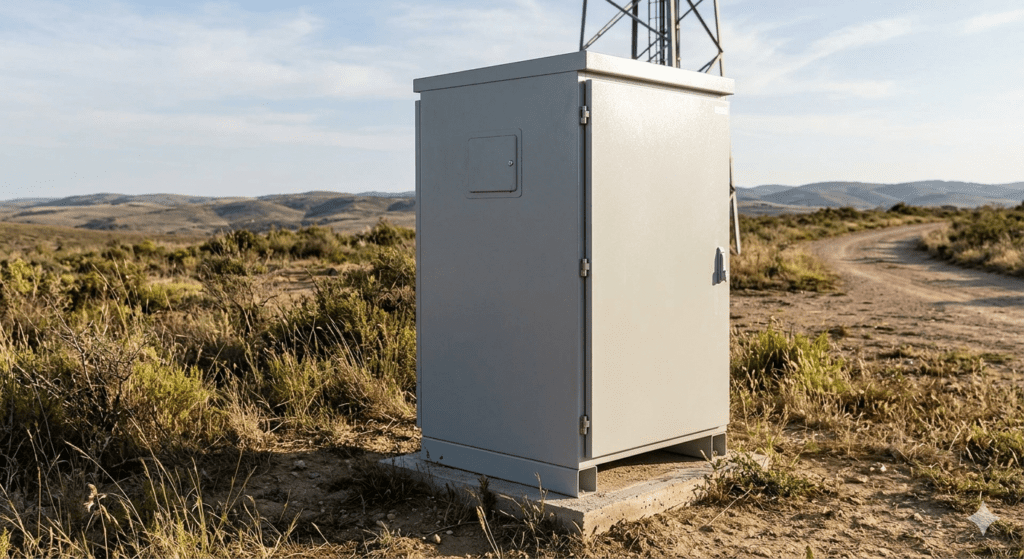
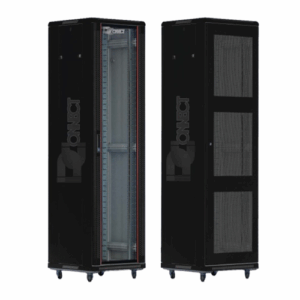
An outdoor telecom cabinet, also called an outdoor network cabinet, street cabinet, or industrial outdoor enclosure, is a weatherproof, vandal-resistant housing unit used to protect telecommunications and networking equipment deployed in outdoor environments.
These cabinets can house a wide range of equipment including fiber optic distribution frames, ONU/OLT devices, routers, switches, power distribution units (PDUs), batteries, and UPS systems. They are designed to operate in temperature extremes, high humidity, dusty deserts, coastal salt spray, and high-security locations.
In short: if your telecom hardware lives outside, it needs to live inside an outdoor cabinet.
Environmental Protection, How Outdoor Cabinets Handle the Elements
The biggest enemy of outdoor telecom equipment is the environment. Here is how a quality outdoor cabinet fights back.
2.1 IP Rating: Your First Line of Defense
Every professional outdoor telecom cabinet carries an IP (Ingress Protection) rating defined by IEC 60529. This two-digit code tells you exactly how well the cabinet blocks solids and liquids:
- IP55: Protected against dust and low-pressure water jets. Suitable for light outdoor use.
- IP65: Fully dust-tight and protected against water jets from any direction. Ideal for roadside and field deployment.
- IP66: Dust-tight with protection against powerful water jets. Best for coastal regions and high-rainfall environments.
- IP67/IP68: Submersion-resistant. Used in flood-prone areas or underground installations.
For operators deploying in humid regions like Nigeria, Congo, Kenya, Uganda, Tanzania, or Djibouti, IP65 or higher is the recommended minimum. In the Gulf, UAE, Saudi Arabia, Qatar, Oman, Kuwait, Bahrain: where sandstorms are frequent, full dust-tight protection (IP6X) is essential.
2.2 Thermal Management and Temperature Control
Heat is the silent killer of electronic equipment. Outdoor cabinets deployed in the Gulf can face ambient temperatures exceeding 50°C. Without proper thermal management, internal temperatures can rise to damaging levels within minutes.
Modern outdoor telecom cabinets use multiple cooling methods:
- Passive ventilation: Natural airflow design with filtered vents for moderate climates.
- Active fans with air filters: Forced air circulation for higher heat loads while keeping dust out.
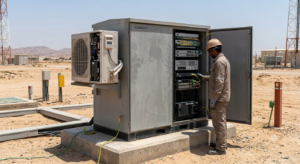
- Air conditioner (AC) integration: Built-in or externally mounted climate control units for high-density equipment or extreme heat. Commonly seen in industrial outdoor cabinet AC models across Saudi Arabia and Iraq.
- Heat exchangers: Sealed cooling without external air exchange, ideal for extremely dusty or coastal environments.
- Thermoelectric cooling: For smaller, low-power applications in remote locations.
D Connect’s Industrial Outdoor Cabinet AC range is specifically engineered for the high-temperature environments seen across the Gulf and MENA region, maintaining safe internal temperatures regardless of what is happening outside.
2.3 Corrosion Resistance and Material Quality
In coastal areas like Djibouti, Somalia, Bahrain, Kuwait, and parts of South Africa, salt spray corrosion is a major concern. Quality outdoor cabinets address this with:
- Cold-rolled steel with polyester powder coating: Provides strong corrosion resistance and UV stability.
- 304 or 316 stainless steel options: For the most demanding marine and coastal deployments.
- Galvanized internal frames: Prevents internal rust even if condensation occurs.
- Double-wall construction: Creates an insulating air gap that reduces temperature transfer and condensation.
2.4 UV and Solar Radiation Protection
In regions like Morocco, Egypt, Libya, Ghana, and across the Arabian Peninsula, direct sunlight and UV radiation can degrade plastics and heat equipment rapidly. Outdoor cabinets mitigate this through:
- UV-stabilized powder coatings that resist fading and cracking.
- Light-colored or RAL-specific exterior finishes that reflect rather than absorb solar heat.
- Roof canopies or sun shields on larger cabinets to reduce direct solar loading.
Security Features: Protecting Your Equipment from Theft and Tampering
In rapidly developing telecom markets across Africa and the Middle East, equipment theft and vandalism are real operational concerns. A good outdoor telecom cabinet is a physical security system in its own right.
3.1 Locking Mechanisms
- Three-point locking systems: Secure the door at three points simultaneously, making forced entry extremely difficult.
- Cam locks with master key systems: Allow network operators to use a single key across multiple cabinet deployments.
- Electronic locking: Supports audit trails, PIN codes, or remote access management for high-security deployments.
- Anti-drill and anti-pick cylinder locks: Used in high-crime-risk urban deployments across Lagos, Nairobi, Johannesburg, and Cairo.
3.2 Structural Integrity
- 2mm or 3mm steel body construction: Resists bending, drilling, and cutting attempts.
- Concealed hinges: Prevents hinge-pin removal attacks.
- Base anchor bolt patterns: The cabinet mounts to a concrete plinth, preventing the entire unit from being removed.
- Tamper-proof fasteners: Special screws that cannot be removed with standard tools.
3.3 Smart Monitoring Options
D Connect’s Intelligent Outdoor Integrated cabinets go further, offering:
- Door-open sensors and alerts sent to network operations centers (NOC).
- Temperature and humidity sensor integration.
- CCTV-ready mounting points for integration with surveillance systems.
- Remote monitoring compatibility through SNMP or cloud dashboards.
Durability and Build Standards, What to Look For
Not all outdoor cabinets are built equally. When evaluating durability, here are the key standards and certifications to look for.
4.1 Key Industry Standards
- IEC 60529: IP rating for ingress protection (the global standard).
- ETSI EN 300 019: Specifies environmental conditions for telecom equipment installed outdoors.
- IK Rating (IEC 62262): Impact protection rating. IK08 withstands 5 joules; IK10 (the maximum) withstands 20 joules equivalent to a deliberate hammer blow.
- RoHS Compliance: Ensures materials are free from hazardous substances.
- CE Marking: Confirms conformity with European safety, health, and environmental requirements.
4.2 Expected Lifespan
A well-specified outdoor telecom cabinet deployed in the Gulf or Africa should have a design life of 15 to 25 years when properly maintained. Key durability factors include:
- Quality of steel gauge and surface treatment.
- Gasketing material quality, silicone gaskets outperform neoprene in extreme temperatures.
- Quality of hinges, locks, and hardware, these are the first parts to fail in budget cabinets.
- Cooling system reliability, AC units and fans need periodic servicing to maintain performance.
Types of Outdoor Telecom Cabinets and Their Applications
Choosing the right cabinet type depends on your network architecture, equipment density, available power, and deployment environment.
|
Cabinet Type
|
Best For
|
Key Feature
|
|
Industrial Outdoor Cabinet
|
High-density equipment, base stations
|
Heavy-duty steel, full climate control
|
|
Industrial Outdoor Cabinet AC
|
Gulf & tropical climates
|
Integrated air conditioning unit
|
|
Intelligent Outdoor Integrated Cabinet
|
Smart network deployments
|
Remote monitoring, sensor integration
|
|
UPS and Battery Cabinet
|
Off-grid or power-unstable sites
|
Battery backup, power protection
|
|
FTTH ONU Cabinet
|
Last-mile fiber distribution
|
Compact, IP65+, fiber-optimized
|
|
Outdoor Smart Surveillance Box
|
Remote CCTV and IoT deployments
|
Solar/UPS powered, PoE support
|
Installation Guide: How Outdoor Telecom Cabinets Are Deployed
Proper installation is as critical as the cabinet itself. Here is a step-by-step overview of how outdoor telecom cabinets are professionally deployed:
- Site Survey: Assess environmental conditions: temperature range, humidity, sun exposure, flood risk, vandalism history, and available power.
- Foundation Preparation: Pour a concrete plinth or prepare a mounting surface. Cabinet anchor bolts are embedded into the concrete for stability and anti-theft security.
- Cabinet Positioning: Orient the cabinet to minimize direct solar exposure on doors and ventilation areas. In sandy regions (Gulf, Sahara, Sahel), position intake vents away from prevailing winds.
- Cable Entry: Use cable glands and conduit entry points at the bottom of the cabinet. Seal all entry points with appropriate glands to maintain IP rating integrity.
- Equipment Mounting: Install equipment on 19-inch or 21-inch rack rails inside the cabinet. Follow proper weight distribution guidelines.
- Power Connection: Connect AC power or solar/battery input. Install PDUs and UPS systems as required.
- Cooling Configuration: Set thermostat controls for fans or AC units. In Gulf deployments, AC setpoints are typically configured for 25°C internal temperature.
- Grounding and Earthing; All outdoor cabinets must be properly earthed to protect equipment from lightning and electrical surges: critical in storm-prone regions like Nigeria, Ghana, Kenya, and Ethiopia.
- Final Sealing and Commissioning: Inspect all gaskets, close cable entries, lock the cabinet, and run a commissioning checklist.
Choosing the Right Cabinet for Your Region
Different climates across the Gulf and Africa demand different specifications.
Gulf Region: UAE, Saudi Arabia, Qatar, Kuwait, Oman, Bahrain, Iraq
The Gulf presents one of the most challenging environments for outdoor equipment globally: extreme heat (up to 55°C ambient), frequent sandstorms, high humidity in coastal areas, and intense UV radiation.
- Minimum IP65 rating, preferably IP66.
- Mandatory active cooling, integrated AC units are the standard.
- Light-colored exterior (RAL 7035 light grey is common) to reduce solar heat absorption.
- Anti-sand filtered ventilation for fan-cooled variants.
- Stainless steel or heavy powder-coated hardware for coastal sites in Bahrain, Kuwait City, and Abu Dhabi.
North Africa: Egypt, Morocco, Libya
Similar to the Gulf in terms of heat and dust exposure, but with varying humidity levels. Coastal sites in Alexandria or Casablanca require corrosion protection, while inland Saharan deployments prioritize dust sealing.
- IP65+ with anti-sand filters.
- Active or passive cooling depending on altitude and site.
- UV-resistant coatings are essential.
Sub-Saharan Africa: Nigeria, Ghana, Tanzania, Kenya, Rwanda, Uganda, Ethiopia, Congo, Somalia, Djibouti
High humidity, tropical rainfall, and difficult terrain are the defining challenges. Flooding can be a concern in low-lying deployments, and power supply is often inconsistent, making UPS integration critical.
- IP65 or IP66 minimum, consider IP67 for flood-prone zones.
- UPS and battery cabinets for power-unreliable sites.
- Corrosion-resistant coatings for humid tropical environments.
- Solar-powered surveillance integration for remote off-grid sites.
South Africa: Johannesburg, Cape Town, Durban
South Africa has well-developed telecom infrastructure but faces unique challenges: significant temperature variation between coastal and highland regions, and unfortunately high levels of equipment theft.
- IK10-rated impact resistance for high-risk urban deployments.
- Advanced locking with alarm integration.
- Active cooling for high-density data center edge deployments.
Azerbaijan and Georgia
These Caucasus-region markets face cold winters and hot summers, seismic activity, and rapid network expansion. Cabinets here need wide temperature operating ranges (often -40°C to +55°C) and robust mounting hardware.
- Wide operating temperature range specifications.
- Earthquake-rated mounting for seismic zones.
- Heating elements for cold-weather operation.
Key Benefits of Investing in Quality Outdoor Telecom Cabinets
- Reduced equipment failure rates: Quality cabinets can reduce outdoor equipment failures by up to 70%, according to industry benchmarks cited by the ITU.
- Lower total cost of ownership (TCO): Preventing one major equipment failure often pays for the cost of a premium cabinet multiple times over.
- Faster network rollout: Pre-integrated cabinets with power, cooling, and mounting hardware arrive ready to deploy, reducing installation time by 30–40%.
- Regulatory compliance: Many markets in the GCC and Africa require telecom infrastructure to meet specific ingress protection and safety standards.
- Scalability: Modular cabinet designs allow for capacity expansion without full replacement.
- Brand credibility: Operators deploying visibly robust infrastructure signal reliability to enterprise and government clients.
Industry Trends Shaping Outdoor Telecom Cabinets
- 5G Edge Deployments: The densification of 5G networks is driving demand for smaller, street-level outdoor cabinets (micro and nano cabinets) capable of housing edge compute and radio equipment simultaneously.
- Solar-Integrated Cabinets: Off-grid deployments across rural Africa are increasingly powered by integrated solar panels and battery systems, eliminating the need for grid power entirely.
- Smart Cabinet Management: AI-powered monitoring systems can now predict cooling failures, battery degradation, and security breaches before they cause downtime.
- Green Telecom Standards: Operators are under growing pressure to reduce energy consumption. Free-cooling technologies that use outside air when ambient temperatures permit are gaining traction.
- Hybrid Power Systems: Cabinets integrating solar, grid, and generator inputs with intelligent switching are becoming standard for Sub-Saharan Africa deployments where grid reliability is low.
How to Order Outdoor Telecom Cabinets from D Connect
D Connect is a manufacturer and supplier of industrial-grade outdoor telecom cabinets, serving operators across the Gulf (UAE, Saudi Arabia, Qatar, Kuwait, Oman, Bahrain, Iraq), Africa (South Africa, Nigeria, Kenya, Tanzania, Ghana, Egypt, Morocco, Libya, Ethiopia, Rwanda, Uganda, Congo, Djibouti, Somalia), and additional markets in Azerbaijan and Georgia.
Here is how to get started:
- Define your requirements: Equipment list, rack unit (U) requirements, power input, cooling needs, and deployment environment (IP rating, operating temperature).
- Contact D Connect: Reach out via the website, email, or phone. Our technical team will review your specifications and recommend the optimal cabinet configuration.
- Request a quotation: Receive a detailed quotation including product specifications, lead time, and shipping options to your region.
- Order confirmation and production: Once confirmed, cabinets are manufactured to your specifications. Standard lead times apply for custom configurations.
- Shipping and logistics: D Connect ships globally, with established logistics routes to GCC ports, East Africa, West Africa, and South Africa.
- After-sales support: Technical documentation, installation guidance, and warranty support are provided with every order.
Frequently Asked Questions
Q1. What is an outdoor telecom cabinet and what is it used for?
An outdoor telecom cabinet is a weatherproof, secure metal enclosure designed to house and protect telecommunications and networking equipment deployed outside of buildings. They are used by telecom operators, ISPs, and network engineers to protect fiber optic equipment, routers, switches, batteries, and power systems from environmental conditions, theft, and physical damage.
Q2. What IP rating should I choose for an outdoor telecom cabinet?
For most outdoor deployments, IP65 is the minimum recommended rating — fully dust-tight and protected against water jets from any direction. In environments with heavy rain, flooding risk, or coastal salt spray (Gulf coast, Djibouti, South Africa), IP66 or IP67 should be specified. In the Gulf where sandstorms are common, full dust-tight protection (IP6X as a minimum) is essential.
Q3. How do outdoor telecom cabinets stay cool in hot climates like the Gulf?
Outdoor cabinets use several thermal management methods depending on heat load and ambient temperature. Passive vented designs work in mild climates. Active fan cooling with air filters suits moderate heat loads. In Gulf environments where temperatures regularly exceed 45–50°C, integrated air conditioning units are the professional standard, maintaining internal temperatures at safe operating levels regardless of external heat.
Q4. Are outdoor telecom cabinets secure against theft and vandalism?
Yes, quality outdoor telecom cabinets incorporate multiple security features including three-point locking systems, anti-drill and anti-pick cylinder locks, concealed hinges, tamper-proof fasteners, and heavy-gauge steel construction. For high-risk deployments in urban Africa or remote sites, advanced options include electronic locking with audit trails, door-open alarms, and IK10-rated impact-resistant construction designed to resist deliberate hammer attacks.
Q5. What is the difference between an industrial outdoor cabinet and an FTTH ONU cabinet?
An industrial outdoor cabinet is a larger, heavy-duty enclosure designed for high-density equipment like base station gear, aggregation switches, or power systems. An FTTH ONU cabinet is a smaller, purpose-designed enclosure specifically for fiber-to-the-home distribution points, housing ONU devices and fiber terminations at street level. Both are outdoor-rated, but differ significantly in size, capacity, and intended application.
Q6. Can outdoor telecom cabinets be used in off-grid locations in Africa?
Absolutely. D Connect’s UPS and Battery Cabinet range, combined with solar-powered outdoor smart surveillance boxes, is specifically designed for off-grid or power-unstable deployments common across Sub-Saharan Africa, including rural Nigeria, Uganda, Ethiopia, Congo, and Somalia. These systems integrate solar input, battery storage, and intelligent power switching to maintain 24/7 operation without grid dependency.
Q7. How do I choose the right size outdoor telecom cabinet?
Start by listing all hardware to be housed and count the total rack units (U) required. Add 20–30% headroom for future expansion. Then consider heat load, higher-density equipment requires larger cabinets with more cooling capacity. Width and depth must accommodate the physical dimensions of your equipment, including cable management space.
Q8. What is an IK rating and why does it matter for outdoor cabinets?
The IK rating (defined by IEC 62262) measures a cabinet’s resistance to mechanical impact. IK08 protects against 5-joule impacts. IK10 the highest rating protects against 20-joule impacts, equivalent to a deliberate hammer blow. For deployments in high-risk areas or locations with a history of vandalism, IK10 is highly recommended.
Q9. Do outdoor telecom cabinets come with integrated power distribution?
Yes, most professional outdoor telecom cabinets include internal power distribution options. This can range from simple AC distribution bars to fully managed PDU systems with per-port metering and remote switching. For sites with unreliable grid power, UPS integration and battery backup systems are available as integrated solutions, all housed within the same cabinet footprint.
Q10. How long does it take to receive outdoor telecom cabinets ordered from D Connect?
Lead times vary depending on the cabinet specification and volume ordered. Standard models are typically available from stock or with short production lead times. Custom configurations — specific colors, dimensions, integrated AC units, or special locking systems — may require 4 to 8 weeks of production time. D Connect ships to GCC, Africa, and international destinations.
Q11. What maintenance do outdoor telecom cabinets require?
Recommended maintenance includes: quarterly inspection of door gaskets for integrity, annual cleaning of air filters and cooling system components, periodic lubrication of locks and hinges, inspection of cable glands for seal integrity, and battery condition checks in UPS-integrated systems. Intelligent cabinets with remote monitoring can automate most of this through sensor-based alerts.
Q12. Can I get custom outdoor telecom cabinets for specific project requirements?
Yes. D Connect manufactures outdoor telecom cabinets to custom specifications including specific IP ratings, IK ratings, RAL color codes, door configurations, internal rack layouts, integrated cooling types, power systems, and security features. Custom orders are available for both small project quantities and large-scale network rollouts.
Conclusion: Protect Your Network Investment with the Right Outdoor Cabinet
Outdoor telecom cabinets are not just metal boxes. They are the silent guardians of your network infrastructure, protecting equipment worth thousands of dollars from environments that would destroy unprotected hardware within weeks.
From the scorching heat and sandstorms of the Gulf to the humid tropical conditions of Central and East Africa, from the coastal salt spray of South Africa to the volatile weather of the Caucasus, every deployment environment demands a thoughtfully specified outdoor cabinet solution.
The right outdoor cabinet delivers:
- Environmental protection through IP65+ ratings and active cooling
- Physical security through robust locking and impact-resistant construction
- Long operational life through quality materials and manufacturing standards
- Peace of mind through smart monitoring and remote management capabilities
D Connect is your trusted partner for outdoor telecom cabinet solutions across the Gulf, Africa, and beyond. With a comprehensive product range from industrial outdoor cabinets to intelligent integrated solutions, solar-powered surveillance boxes, and UPS battery systems, we have the right cabinet for every deployment scenario.
Ready to Protect Your Network Equipment?
Whether you are deploying a single roadside cabinet in Dubai or rolling out hundreds of outdoor enclosures across Nigeria, D Connect has the expertise and product range to support your project from specification to delivery.